TMS Integration: Common types, complexity, costs and common challenges

TMS Integration is a core component of modern transportation management systems, going far beyond simple data storage. Here’s why:
1 - Facilitate Unified Data Management
Integrations create the basis for unified data across multiple tools. The lack of unified data usually means that there are multiple sources of the truth in your company, for instance on trip sheets, in excel sheets and in your legacy TMS. This creates repeat work, the need to reconcile data and usually is the main culprit for bloated back-office operations in fleets.
2- Seamless Workflow Automation Across Systems
Data that flows seamlessly across systems via integrations allow for seamless and automated workflows. Rather than you entering data multiple times into multiple softwares, you enter it once and then it synchronizes across into other platforms.
3 - Real-Time Optimization Powered
Seamless data and workflows enable real-time optimization. Integrations make it possible that you can apply real time algorithms and guide dispatchers in their dispatch decision at the very moment when they are about to assign a truck and driver to a load.
4 - API-Based TMS Integration Is Replacing All-in-One Systems
The rapid spread of API connections has started to make it easy, reliable and cheap for systems to connect with and transfer data between each other. This simultaneously has made it less attractive to have one big, all-in-one system. As a result, we see many mid-sized and large fleets to move away from an all-in-one TMS-accounting bundle to using a best-in-class, professional accounting system and a best-in-class transportation management system.
This shift is especially important in finance workflows. As fleets move away from bundled legacy systems, they often need tighter coordination between dispatch execution and back-office processes such as invoicing, settlement, cost tracking, and reconciliation. That is why TMS and accounting integration has become a critical part of a modern best-in-class software stack.
ERP To TMS Integration
For some fleets, their existing dispatch software is part of their ERP. This results in manual processes where human effort, keystrokes, and paper make up for the shortcomings of the ERP. This is very a common bottleneck that is mostly solved by deploying more manpower - a complete deterrent to growth.
Today these very often menial tasks can be automated freeing your team to work on the business rather than just in it. Common ERPs include SAP, Oracle, IBM, TMW's Innovative or TL2000, and others. These systems may reside on older servers or mainframes, predating the widespread use of APIs. Connecting with them often requires careful thought of data flows beyond simple ODBC connections or screen scraping.
Complexity
Moderate to High - In terms of one-time software development these can be extensive and then there is maintenance as the connections can be brittle - ERP could stand for Executive Revenue Pulverizer in some cases but each one is different and depending on the scope may be that bad.
Relative ROI
High - Imagine eliminating thousands of hours of manual work that costs money, demoralizes teams, produces errors, and disappoints customers - There you have why this type of connection is often worth the cost.
Cost
Moderate to High
Degree of Maintenance
Moderate - it breaks and you might to involve technical resources to fix it.
ERP To TMS Integration Benefits
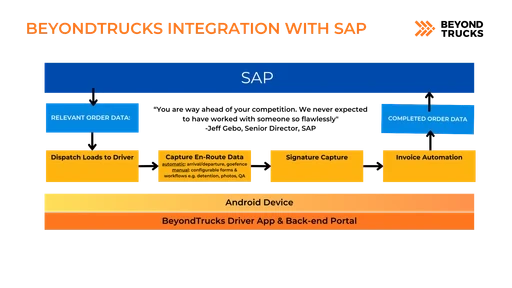
ERPs are the backbone of many businesses. By integrating your ERP with BeyondTrucks, you gain the power of modern fleet management capabilities without a complete system overhaul. Your ERP remains in place while BeyondTrucks becomes the streamlined conduit for connecting all your other point solutions – ELDs, fleet management, paperwork digitization, and more. The graphic on the right provides an example of a how we can integrate into SAP eliminating reams of paper waste, and manual processes.
Example: BeyondTrucks connection to SAP through an API was a first earning us the praise from their team (see quote in graphic.)
Can EDI and TMS be integrated?
Electronic Data Interchange (EDI) remains the time-tested standard for structured communication within the trucking industry - it’s how Ross Perot made much of his fortune. In simple terms, it's a set of technical standards for exchanging load tenders, shipment updates, and more. EDI's strict formatting ensures reliability but can also introduce rigidity. In the 1990s, there were claims that XML was going to replace EDI but, as it stands today EDI appears to maintaining its place in the trucking.
For many fleets, EDI is still one of the most operationally important forms of TMS integration because it connects customer communication, shipment visibility, document exchange, and service responsiveness in a single workflow. Fleets that rely on load tenders, invoices, shipment updates, and customer scorecards often need a more structured approach to customer EDI integration than a generic interface can provide.
Example: A majority of our customers have EDI connections either we at BeyondTrucks maintain or are managed by a third party. Carriers are often rated by shippers on their EDI responsiveness so monitoring that you are sending the right signals is crucial.
Complexity
Moderate to High - This depends on who handles it for you and your team’s technical ambition.
Cost
High to Moderate - It’s on a per-transaction basis.
Relative ROI
Moderate to High - Some of your customers may require it.
Degree of Maintenance
Low to Moderate - this is not something you would do on your own. Some carriers have 100s of EDIs and companies like Cleo can play the role of middleware provider.
TMS Integration with API
APIs (Application Programming Interfaces) are considered a modern, flexible way to exchange data in real time. API-based integrations are especially valuable when fleets need real-time connectivity between the TMS and other operational systems such as ELD platforms, warehouse systems, fuel card providers, and specialized fleet tools. Instead of relying on manual updates or batch uploads, API integrations help transportation teams build faster, more connected workflows across dispatch, compliance, financial control, and shipment execution.
BeyondTrucks's cloud architecture enables us to offer seamless integrations with numerous partners. This connectivity is one of the core values of a multi-tenant cloud system. Once an integration is built between two multi-tenant SaaS providers (say BeyondTrucks and ELD providers like Samsara or FMS solutions like Fleetio), the two platforms can connect users without building an integration each time a user needs to cost. This is highly cost efficient and convenient, since users only need to enter their API key (i.e. a uniquely identifying password) to connect their systems and then route their data.

We offer a library of API connections for TMS Integration
Example: In our library of integrations, you select your vendor and input your API key and it the connection is virtually instant. Compared to integrating with a legacy TMS this is a breath of fresh air.
In practice, fleets rarely need just one integration. They often need an ecosystem of connected systems that includes TMS and WMS integration and, in some cases, TMS and fleet management system integration. The stronger the integration architecture, the easier it becomes to replace disconnected workflows with a more unified and real-time operating model.
Complexity
Cost
Relative ROI
High - The value is directly related to the data you can capture and submit. But, just because a vendor or business partner offers an API for your TMS to connect with does not mean it will provide all the data points you need.
Degree of Maintenance
Low - this is impacted when, for example, a vendor changes their code and it impacts the API. If they are committed to that interoperability, it may just be a simple restart of the connection - a few clicks from a non-technical user on your team.
Flat File for TMS Integrations
You are probably using this method throughout your business (marketing, payroll, inventory, etc) and it’s questionable to be considered an integration but it deserves mention. Flat files (CSV, Excel) still have their place for simple data transfers or when connecting disparate systems internally or between customer and carrier. For instance, a customer might send their carrier a list of orders in a consistent format. BeyondTrucks is realistic and knows work outside TMS will always happen and we make uploading to our system easy.
Flat files can still be useful in lower-maturity environments, but they usually fall short when fleets need real-time visibility, continuous synchronization, or tighter process control across customer, compliance, warehouse, and financial systems. As operations grow more complex, many teams move from manual uploads toward more durable API or EDI-based TMS integrations.
Complexity
Low
Cost
Low
Relative ROI
Moderate - It eliminates a lot of keystrokes.
Degree of Maintenance
Low - Changes in tables are the one area that has an impact on this.
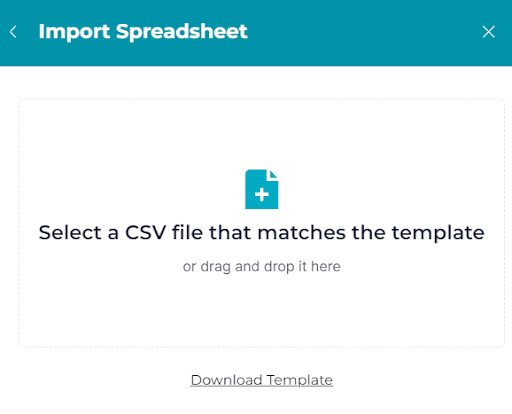
Example: A customer may send you a spreadsheet of all the orders every Thursday. We could automate that ingestion or you could have your team upload it with two clicks (see graphic).
If you have questions about integration possibilities with BeyondTrucks please contact us at 205-881-3975 or info@beyondtrucks.com
Ready to Elevate Your Fleet Operations?
Explore BeyondTrucks Transportation Management System Today